Travel to Ireland
Day 2 Belfast (0 Km.)
Belfast: We begin the visit of Belfast, the capital and largest city of Northern Ireland, visiting its famous murals. Murals in Northern Ireland are an example of political muralism, having become historical symbols that essentially describe the past and present divisions of the region. In Northern Ireland, and mainly motivated by the armed conflict known as the Troubles, are some of the most famous murals of political symbology. Over time and after the end of the conflict with the 1998 Good Friday Agreement, the murals have become a tourist attraction of Ulster.
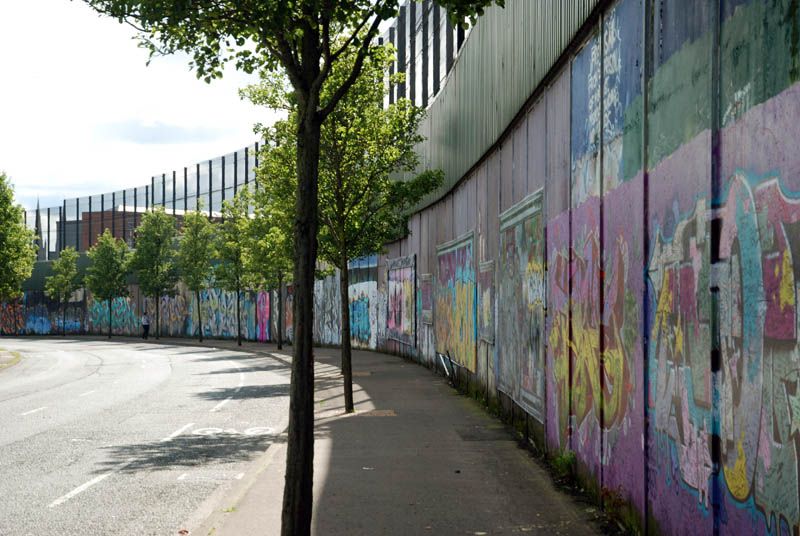
Belfast - Peace Wall at Cupar way
The first murals we see are the peace wall in Cupar way, from the Protestant side. Peace walls are a series of barriers that separate Catholic and Protestant neighborhoods in the cities of Northern Ireland, especially in Belfast. Its objective was to limit the confrontations between these two communities. They have a variable length (from a few hundred meters to more than 5 km), are made of iron, brick, concrete and steel and can reach a height of up to 8 meters. Sometimes they are equipped with metal meshes to prevent the launch of Molotov cocktails, rockets, bottles and stones from one side to the other.
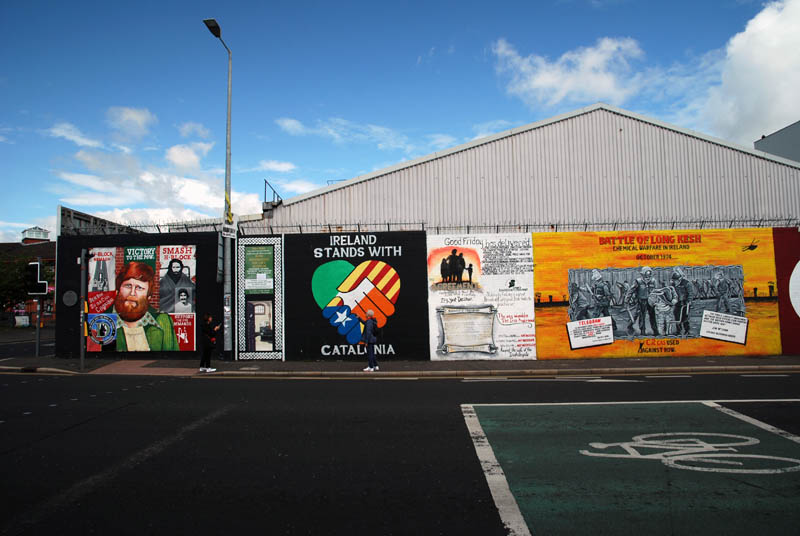
Belfast - Falls Road murals
Over the years they have become a kind of tourist attraction and, like the murals, are part of bus and tourist taxis routes. One of the most famous sections of the wall is the one that separates Falls Road (Catholic) from Shankill Road (Protestant). In 1969 and 1970, Falls Road became one of the main scenes of the civil conflict in Northern Ireland. In the corner of Falls road with Northumberland St we find the so-called International Wall, with murals that support from Mandela, the Cuban revolution and even the Catalan people. Finally we visit Shankill Road, a Protestant and unionist fief, where we find, for example, murals supporting Queen Elizabeth.
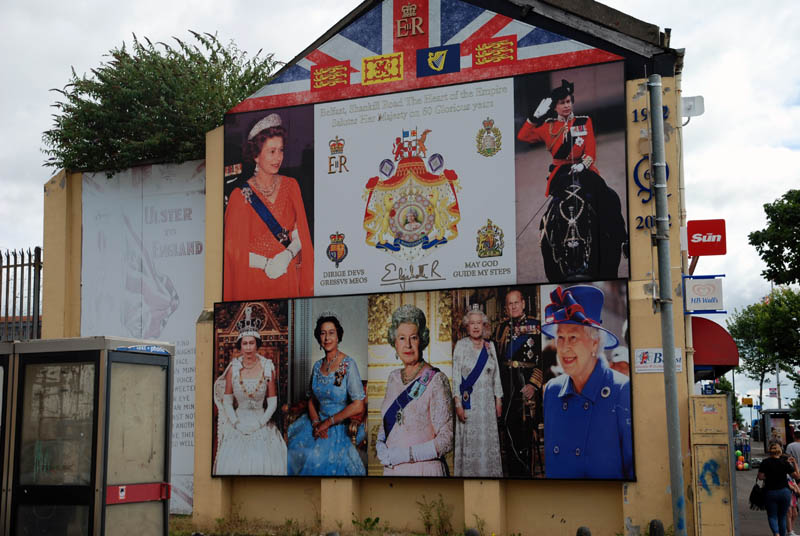
Belfast - Shankill Road murals
We move to the city center, starting the visit by the Big Fish. The Big Fish, also called The Salmon of Knowledge is a printed ceramic mosaic sculpture by John Kindness. The 10-meter-long (33-foot) statue was built in 1999 and installed in Donegall Quay, near the Lagan viewpoint and the Custom House. A few meters away we find the Albert Memorial clock, an 1869 clock tower located in Queen's Square. The sandstone memorial stands 113 feet tall in a mix of French and Italian Gothic styles. The base of the tower features flying buttresses with heraldic lions. Nearby we find the St Anne's Cathedral, from the beginning of the 20th century.

Belfast - Big Fish
As it starts to rain, we decided to shelter in the most famous museum in the city. On March 31, 2012, a museum dedicated to the RMS Titanic, known as Titanic Belfast, was inaugurated. The six floors of the museum explore the history of the Titanic, the people and the city that built it and also has a live connection with the remains of the ship. The facade of this modern interpretation center of six floors and 14,000 square meters has the shape of four bows, all of the same height as the authentic Titanic from the keel to the deck. Outside the building you can visit the SS Nomandic, another of the White Star Line company ships, the same as the Titanic.

Belfast - Titanic Belfast
We left the Titanic Belfast and after crossing the Queen's Bridge we went to the financial area, parking the car in Victoria Square, a huge shopping center opened in March 2008 and dominated by a huge glass dome. A few meters away is the St. George's Market, a Victorian-style covered market built between 1890 and 1896, frequented by tourists, where we find food stalls and handicrafts. In 2019 it won the prize for the best covered market in the United Kingdom.

Belfast - City Hall
The City Hall was finished in 1906 and was built to reflect Belfast's city status, granted by Queen Victoria in 1888. The Edwardian architectural style of Belfast City Hall influenced the Victoria Memorial in Calcutta, India, and Durban City Hall in South Africa. The dome is 173 ft (53 m) high and figures above the door state "Hibernia encouraging and promoting the Commerce and Arts of the City". The interior has a number of notable features including the Porte-Cochère and Grand Entrance, the Grand Staircase, the Reception Room and the Great Hall. Around the building are beautiful gardens, in one of which we find the Titanic Memorial that was erected to commemorate the lives lost in the sinking of the RMS Titanic on 15 April 1912.